J’s Take on Point of Hopes by Melissa Scott and Lisa A. Barnett

Point of Hopes is one of those titles that you can never quite remember. This is a book, really two books (the other being Point of Dreams to add to the confusion), that I’ve seen in various locations and lists. With the impetus of Triple Take, I’ve now read this one. If I can manage to remember the title of it.

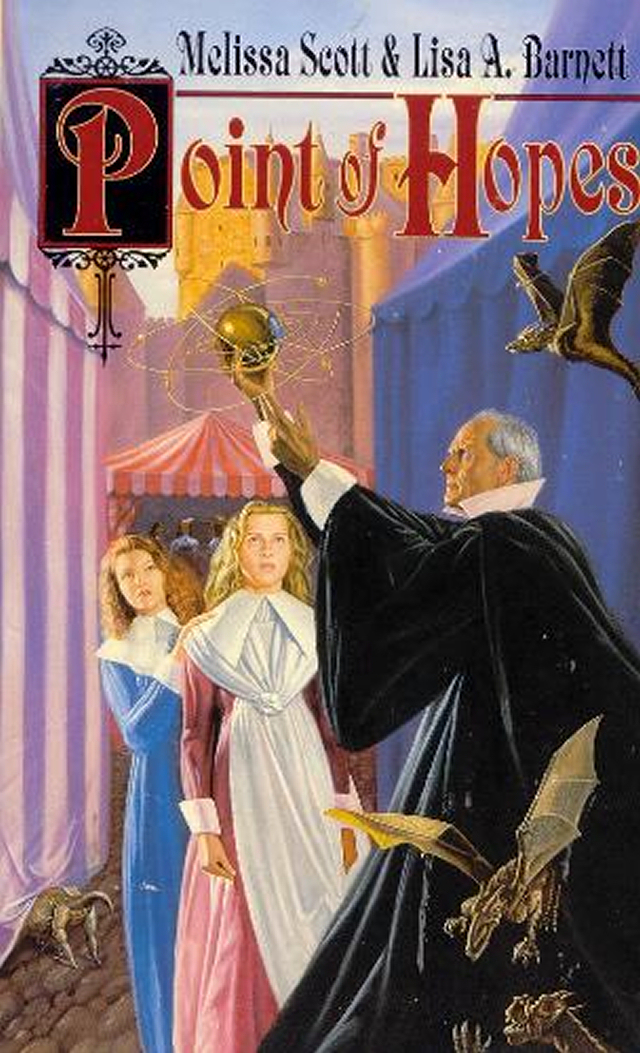
The cover intrigued me. It looked rather Puritan, but it also looked academic, and there were girls, or at least young women. But while I can now say the cover accurately represents an important scene in the book.. none of those first impressions were correct. No, those girls and even that guy in the robe.. none of them are main characters.

We start with an unpromising prologue. I had trouble following whose point of view it was, or in being very interested in it. Fortunately, I know that most prologues have little to do with the style and tone of the rest of the book. Unfortunately, that means you have to sit through them and get to the real first chapter before you can tell whether to give up on the book or not. Extra wasted time and effort.

This book does get better after the prologue. The point of view problems settle down… mostly. As we alternate sections and/or chapters with first one character, Rathe, a pointsman (this world’s version of a police detective), and a second, Eslingen, a militaryman between jobs acting as a hired guard. But I do say mostly, because there’s one section in particular where they’re in the same scene and the point of view gets all jumbled up again. It’s at this point that I wondered if the two authors were collaborating by each taking one character. And that they then had trouble reconciling it when the two had scenes together.

As for the plot, it’s mostly a mystery plot. Children are disappearing from the city and Rathe sees it as his job and calling and obligation to various people and whatnot to try to find out what’s going on. So a lot of the book is him running here, and running there, and talking to people, and collecting clues. And really, do people like reading mysteries and watching all this running around and talking to people? Because I don’t get a whole lot of pleasure out of it.

Things got hopeful when Rathe first lays eyes on Eslingen. He makes a point of noting he’s handsome and what he’s wearing. Which isn’t unusual, in itself, but my ears and eyes were perked for a budding romance. A love story? A romantic subplot at the very least? A friendship that slowly evolves into something more? Well, perhaps it’s a spoiler to say so, but I was denied, dear reader. DENIED!

And not in the usual way.. where all the slash is subtext that I’m probably reading into a normal manly friendship. No. Because the authors make a point of Rathe being surprised Eslingen was interested in women. And you just know, you just know, that Rathe is interested and that Eslingen probably wouldn’t be too against it either. Because there are hints throughout that this is a very bisexual sort of society. Not that everyone is, but that the society as a whole is. So that maybe, maybe, if the story of these two continues in the next book, Point of Dreams, they might move further along in this relationship. But by the end of this book, it’s not much of a relationship. It’s barely even a friendship.

GRR!

One cute thing about this world is there are gargoyles. And they’re basically like rats. They hang around the garbage and are a nuisance, but a somewhat cute sort of nuisance. Maybe more like wild cats combined with pigeons? Anyway, that’s a cool little addition. And you can see them on the cover of the book. Even if you first take them for firelizards.

The end of the book seems rushed. I even started noticing more and more typos. And then the big bad bad guy is defeated waaaaay too easily. And quickly. Perhaps, in that way, it was again more like a mystery than a typical fantasy. In a mystery, it doesn’t matter if you shoot the guy at the end, as long as you’ve proved it’s him and done all your revelations. (Not that he gets shot. That’s just an analogy.)

One other thing I should definitely say is that this book read like a very long slog. Perhaps not a particularly hard slog, but a slog. It took a lot longer to read than it looked like from the size of the book. There were a lot of words crammed onto an individual page and the chapters were incredibly long. I think there were only about 9 or 10 chapters in the whole book. I read it diligently and plowed ahead with it, but it still took me over a week to finish it.

I’m mostly left feeling that I like this world. Women are more or less equal. The gargoyles are a bit of fun. They don’t mind a bit of same-sex fooling around — prevents the apprentices and journeymen from getting pregnant. There’s an interesting political setup with the way the local police are new and still feeling out their role.. which isn’t quite the same as we know police.

But while I do like the world, and the characters aren’t bad, I just can’t like the story. It wasn’t the story I wanted, I guess.

So I’m torn. Do I revisit the world because it’s cool and I want to learn more about it? Because the authors might explore things I was more interested in? Because the main characters might finally hook up? Or do I not subject myself to another long slog for a similar plot and unfulfilled expectations?

I’m going to have to give this one a 3.
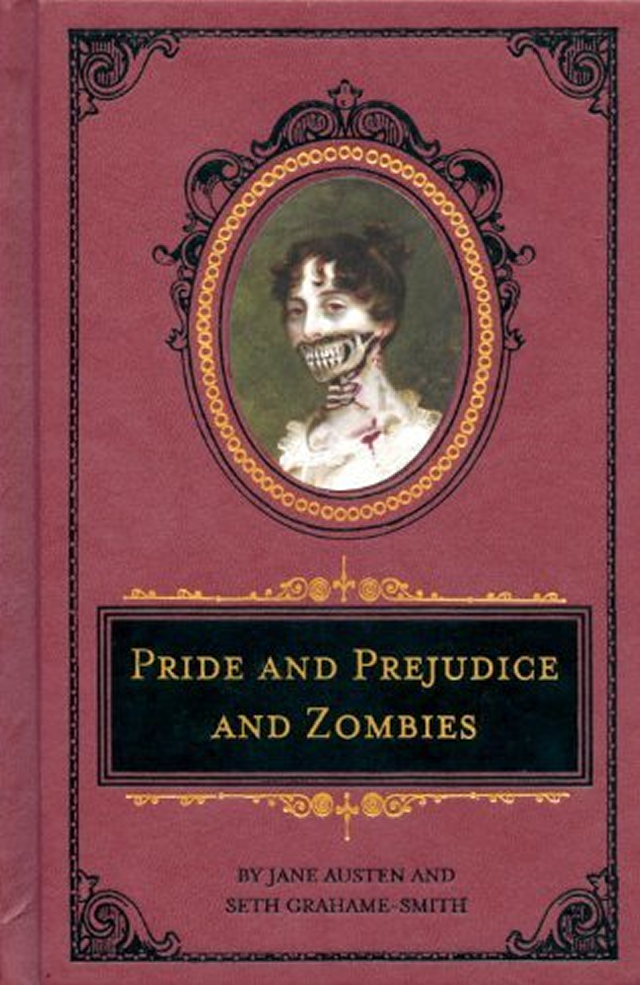
Pride and Prejudice and Zombies (Seth Grahame-Smith)

The Plot
Fifty-five years ago, the British Empire was faced with an uprising of the non-colonial sort: the dead were walking and they wanted brains. The scourge continues unabated, but life has adapted to cope with the continual threat. The five Bennett sisters have all been trained to fight the menace, but their mother would like to see them well married as well. Enter Mr. Bingley, a single young man of good fortune who has just moved into the neighborhood.

My Thoughts
When this book first came out, I resolved not to read it. The original Pride and Prejudice is my favorite book of all time, coming as close as any book has to my idea of perfection: lots of witty, interesting characters saying pithy things to one another and a happy ending to boot. I love it well enough to hate the vast majority of sequels I’ve tried, because they simply couldn’t live up to the original, or they took liberties to which I objected.

At any rate, my resolve weakened against PPZ. The author had kept a great deal of the original text, and the juxtaposition of zombies with the social machinations of the original might be, as one of Austen’s characters would put it, exceedingly diverting.

The premise is this: about a half-century before our story opens, zombies suddenly began appearing to menace the living. They are witless creatures, not impossible to destroy or even to distract, but doggedly determined in their quest for brains. Zombies seem to have two sources: the already dead may rise again, and the living may be infected by exposure (such as being bitten). In response to this, the army has mobilized, and also the general citizenry has begun to train and arm itself. Even women have received some training, including women of quite high station. The opening of a new economic door to women has seemed to have an effect on society: crudeness and innuendo is more common and there is a great deal more violence.

It’s clear from reading that the author has put at least a little thought into how this situation might change polite society. Unfortunately, in many cases it seems to have been very little. It’s hard to tell whether this is meant to be a “serious” retelling of the story or if it’s just meant to be a silly parody. Different rules apply in the latter case, but just enough effort has been made to maintain the integrity of the plot and story that the argument falls flat — this is not the literary equivalent of Scary Movie. And that makes it all the more galling in the cases where it’s abundantly clear that something has been inserted only because Grahame-Smith just couldn’t resist and not because it made sense in either the original or the re-imagining.

I get the sense, too, that the author didn’t have a great deal of respect for(or understanding of?) some of the original characters. In several places, Austen’s original text is included, but the speaker (or writer) is not the same as the original book – and yet they’re using the exact same phrasing. This is just sheer laziness on the part of the author. The work is almost bookended by the two of the most egregious examples of this: first, where Caroline Bingley takes over some of Darcy’s lines in an early exchange with Elizabeth, and then at the end, where a letter originally sent by Mr. Collins is penned instead by Colonel Fitzwilliam. In neither case are either pair of characters in any way similar and so the reassignment of words is out of character even within the context of this new book.

Similar problems arise when Austen’s text is revised for no apparent purpose beyond dumbing it down for the modern reader, something which happens at multiple points. A single example here will suffice to illustrate the danger of this.

Original:
“No. It would have been strange if they had. But I make no doubt, they often talk of it between themselves. Well, if they can be easy with an estate that is not lawfully their own, so much the better. I should be ashamed of having one that was only entailed on me.”

Zombies:
“No; it would have been strange if they had; but I make no doubt, they often talk of it between themselves. Well, if they can be easy with an estate that is not lawfully their own, so much the better. I should be ashamed of putting an old woman out of her home.”

In the original text, we refer back to Mrs. Bennett’s refusal to admit that the entailment of her husband’s estate makes sense or is legitimate. Further, we have a joke: of course the entailment is pefectly legal, that is the entire problem. In the Zombie version, even though there is no zombie-related information conveyed here, the text is altered: the joke is removed and the reader is not reminded that Mrs. Bennett is ridiculous or of the inheritance situation, but instead is apparently meant to feel bad for her.

There are examples of this sort of careless editing all through the text, toning down the snarkiness of the dialogue and the narrator in some sort of misguided quest to make it more simple. In many cases, these changes cause anachronisms to creep in.

In addition to these changes, there are still more points of fail.

The illustrations: These are just awful. The clothing, which is not particularly mentioned in the text as being different in most cases, is just odd looking. Not at all correct for the time period or even sensible allowing adaptations for fighting and training.

The “Oriental” stuff: I’m not even sure where to begin with all of this. Lady Catherine with ninjas is, I’m sure, the vision that made the insertion of all of this stuff irresistible. And I wouldn’t object to it all overmuch (I leave it to someone else to complain about the potential Racefail aspects of it) were there not such a big deal made about Chinese training versus Japanese training. Because even to my non-expert eyes, it was clear to me that the author was making a distinction he was not prepared to follow through with: Chinese-trained Elizabeth fights with a Japanese sword, there are random bits of Chinese culture at Darcy’s supposedly Japan-inspired home, and so forth. If the author was actually Jane Austen, one might suppose these cross-contaminations were a subtle jibe, but unfortunately, based on the rest of the book, Grahame-Smith is incapable of such a thing.

In Short
This was actually a very clever idea, and I think it could have been very good, with just a bit more effort expended on research and editing. Unfortunately, as it stands, this was definitely a failure, as a parody (not enough liberty was taken) and as a true rewrite (it was too slap-dash and sloppy). I don’t quite regret reading it, but I definitely won’t ever be reading it again, nor will I be picking up the next book, even though it’s to have a different author.

More Information Than You Require by John Hodgman: B-

From the front flap:
When John Hodgman first embarked on his project to assemble, tabulate, and completely make up a comprehensive survey of COMPLETE WORLD KNOWLEDGE, he was but a former professional literary agent and occasional scribbler of fake trivia—in short, A NOBODY. But during an interview on The Daily Show with John Stewart, an incredible transformation occurred—he became A FAMOUS MINOR TELEVISION PERSONALITY. Hodgman realized from this unique vantage point that he understood better than ever that THERE IS SOME WORLD KNOWLEDGE YET TO BE DOCUMENTED. And so he has returned, crashing his Kansas farmhouse down upon the wicked witch of IGNORANCE to bring you MORE INFORMATION THAN YOU REQUIRE.

Review:
I’m aware that I have a rather particular sense of humor. And so it’s really not a surprise that I didn’t find More Information Than You Require to be all that funny. I’m more apt to giggle at a silly comment than I am to laugh at a lengthy essay full of clever falsehoods, of which this book is primarily comprised. That isn’t to say that the book is entirely lacking in funny lines—my favorite is “First, get a pig’s spleen. They are often just lying around.”—but that they are few and far between.

Most of the material is at least somewhat amusing, eliciting a snerk here or there, but I don’t think I smiled even once while reading the absolutely ponderous chapter on mole-men near the end; references to Fraggle Rock couldn’t even endear it to me. I didn’t care for the recurring jokes about harm befalling cats, the occasional vulgarity, or the little page-a-day calendar blurbs that disrupted one’s flow of reading and which Hodgman himself seemed to acknowledge as annoying, saying, “You can’t avoid [reading them] forever.”

However! There are also some very nice stories buried in here, those with a more personal feel that seem to be at least marginally grounded in reality. The chapter on being famous, for example, is terrific, and I loved reading Hodgman’s perspective of being recognized. There’s also a really sweet story about vacationing in Portugal as a younger man, waiting for his girlfriend (now wife) to return from a solo journey she’d made, which includes the surprisingly touching line, “And even now, a decade and a half later, when she is out of my sight, I never stop looking for her.”

Alas, I think campaigning for more stories like that would be asking Hodgman to abandon… well, being Hodgman. I still wish the fellow well, but I don’t think I’ll be reading any more of his books. They’re just not my kind of humor.

J’s Take on More Information Than You Require

John Hodgman’s More Information Than You Require is almost more information than I can stand. The premise of the book is.. a whole bunch of facts and trivia and stories that Hodgman made up. The layout fits the title and premise of the book, but really turns me off. Even the cover looks like an overload of information.

The format of the book is random facts and stories and information (mostly false) roughly sorted by topic into chapters. There’s images to spice things up. And sometimes there’s boxes. You almost feel like there would be sidebars and topbars and bottombars, but because every page also contains a Page-A-Day calendar notation, Hodgman really was running out of room.

The way I’d normally read something like this is to read everything on the page before turning the page. Eventually I had to give that up. I stopped reading the calendar entries and my enjoyment of the reading experience improved. But it was still problematic, because there were footnotes to be reading. So there’s just constant interruptions to the flow in my brain.

As for the content itself? Eh. I think this book would be far better used as a bathroom reader. Small doses would be easier to swallow, and more amusing. I did like the entries for July 12, 13, and 14th. July 31st was distinctly lacking in wizard references! I confess to skipping the several-pages-long list of molemen names. (Firefox thinks I spelled molemen wrong. I probably did.)

All in all, I like Hodgman better on television. In small chunks.

J’s Take on A Dooryard Full of Flowers

“A Dooryard Full of Flowers” is the short story sequel to Patience and Sarah by Isabel Miller. Except it would be more exact to call it a very-unfinished novel. I have a bunch of novels in just this state of completion! Well.. perhaps not a bunch, but some.

This story covers the part of the lives of Patience and Sarah that I was most interested in reading about. I wanted to hear about how they set up their home, built it up, made it cozy, faced adversity, got along with the neighbors, etc, etc.

Well, I got an itty bitty bit of that from this story. Lesigh.

The first part, and the large part it, is told from the point of view of a neighboring farmer. And his view of the women is very weird. He seems to think they’re strange, and not get that they’re shacking up together, of course. But he also goes on and on admiring them. Wanting them to be independent and succeed. All the while snickering behind his wife’s back that she thinks the women would be fine wives for their sons. He thinks they’re unsuitable for his sons because.. well, I think basically because they’d be hard to control and just not very pleasant to be married to.

That’s not resolved or anything, but they all pay a visit (sons included), and think the house is dressed up rather frivolously, with all of Patience’s pictures that they don’t realize are Patience’s. And then the wife comes out of it not liking them at all, for some slight or other.

Then we get Sarah’s point of view for a bit. In which we get a completely silly scene involving Patience thinking to be fair and equal, she needs to work in the fields. Which is completely ridiculous if they expect to survive on this stupid farm. She decides she’s rubbish at the hoeing and whatnot, because she’s not wearing pants. So then, IN THE MIDDLE OF THE WORKING DAY, they trot back home so Sarah can undress and a pattern of her clothes can be cut, so Patience can make similar clothes for herself.

And well, that’s about it. The story, or the novel fragment, or whatever you want to call it, stops.

Two girls try to play house and farm, and are all set to utterly fail and starve to death.