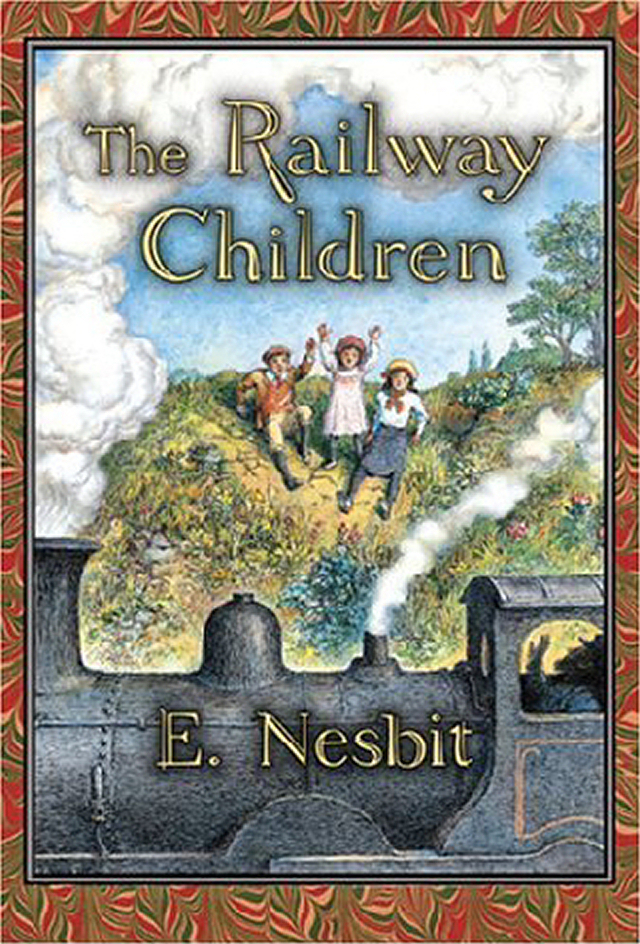
The Railway Children by E. Nesbit is K’s suggestion to the two of us to read. I didn’t really know much about this book going into it. I had read probably only one other book by the author, and that was Five Children and It. So I suppose I had a rough time period in my head, an idea that it might be fantasy. And would involve children and trains.
I read this off of Project Gutenberg, first online (for something to do while trapped at a computer) and then on my Sony e-reader. Let me just take one paragraph to rave about PG. They have free, legal books! In nicely-formatted EPUB! DRM-free! Did I mention free? And quality? We should read more public domain books so I can read them this way. Only one minor quibble: in one instance the children all run their words together without spaces. The EPUB format and my e-reader combined meant I only saw part of that. It didn’t line-wrap. The condition was made worse when I increased the font size. So that’s something to be ware of if you’re editing your work and youhaveasentenceyou’vewrittenlikethisforeffect. Maybe throw in a space. I don’t think a hyphen will work, but it might.
Moving on..
Three siblings are the focus of this story. We meet them in their natural habitat, living a comfortable life in the city with servants and whatnot. But foreshadowing and then calamitous circumstances befall them. Rather mysterious ones. Their father goes off and their mother is in tears, but won’t tell them anything. And at first I made the connection with things that were said with the title of the story and thought we were in for a story about the child evacuation of London. Until I recalled that this book was at least 20 years older than that. And a vague idea it was closer to 40 years before that.
Once I got over that notion, it didn’t take long to realize where their father had gone. If I had read this when I was a kid, I don’t think I would’ve picked up on it quite so quickly. But since I did, it was a little annoying that their mother wasn’t just straight with them and telling them what was going on. Just that all of a sudden they’re poor and have to move to the country.
Once there, their mother spends all her time writing, so the kids are left on their own to amuse themselves. They discover the train station and spend a lot of time there after that. And I learned way more about trains than I ever really wanted to know.
The chapters tended to be episodic. Not quite like short stories strung together, but quite like a serial. And the impression that it was a serial became very strong near the end where one chapter ends with the kids shouting, and the next chapter picks up with them repeating it and a short reiteration of their circumstances.
So if it was a serial, I will forgive one quibble I had with it, which is that time will have passed and they’ll be on to something new and the author will throw in like ‘oh yea, when they first got here, they each started a garden’. This wasn’t important to mention at the time it happened? I hate when authors do that.
As for the episodes, the children explore places and meet new people. And do rather a lot of saving people. When their mother is sick, when debris falls on the tracks, when a kid hurts his leg, when a boat catches on fire. I think England was a dangerous place a hundred years ago!
On to things I particularly liked. I liked that the girls had male nicknames. And that right in the first chapter, their father is telling them that the girls can fix engines or be a firewoman (meaning, I believe, the person who chucks coals into the er.. furnace, steam, thingee). What was I saying about knowing more about trains now? Heh.
I also liked that the author described some of the emotional, relationship stuff that was going on. I can’t quickly lay my hands on an example, but such as explaining why someone said something or acted the way they did. Or why their mother was reluctant to let them walk on the rails, but ultimately let them, though it hurt her to let them. Just things like that. Which I think would be very helpful to a kid reading the book, especially when it comes to understanding the adult characters. And it was done in a way that didn’t annoy me. Though it probably does require authorial intrusion to get away with it. And reminds me of Lemony Snicket.
As with any story where one of the characters is a writer, as a reader I have to wonder if any of it was autobiographical. I shouldn’t do that, but it’s difficult when she deliberately omits a character’s name. Like if she said it, it would give away the whole game. Or something.
While in the end it wasn’t a fantasy, the detail about the trains that she went into did remind me of science fiction of the 40s and 50s. It could’ve easily been a spaceport and rockets she was describing the workings and everyday running of.
So in the end, I like that this story exposed girls to train technology and exposed boys to interpersonal dynamics. Because I’m quite sure this is a story boys and girls would equally read.
Would I have liked it as a kid? Honestly, I don’t think so. Between the trains and the unfamiliar setting and language of Edwardian England, I think I’d’ve had trouble being interested. Though how I went so long without encountering any of her books, I don’t know.
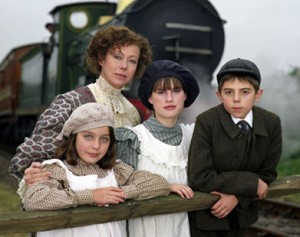
There’s a WGBH live action of this book, produced in 2000 (the image above is from there). Unfortunately, it looks like our library’s copy is missing. I would like to watch it now. K, you have a copy of it on your DVD shelf?




 Super Why: The Ghost Who Was Afraid of Halloween adapted by Samantha Brooke from a script by Jennifer Hamburg (2009)